
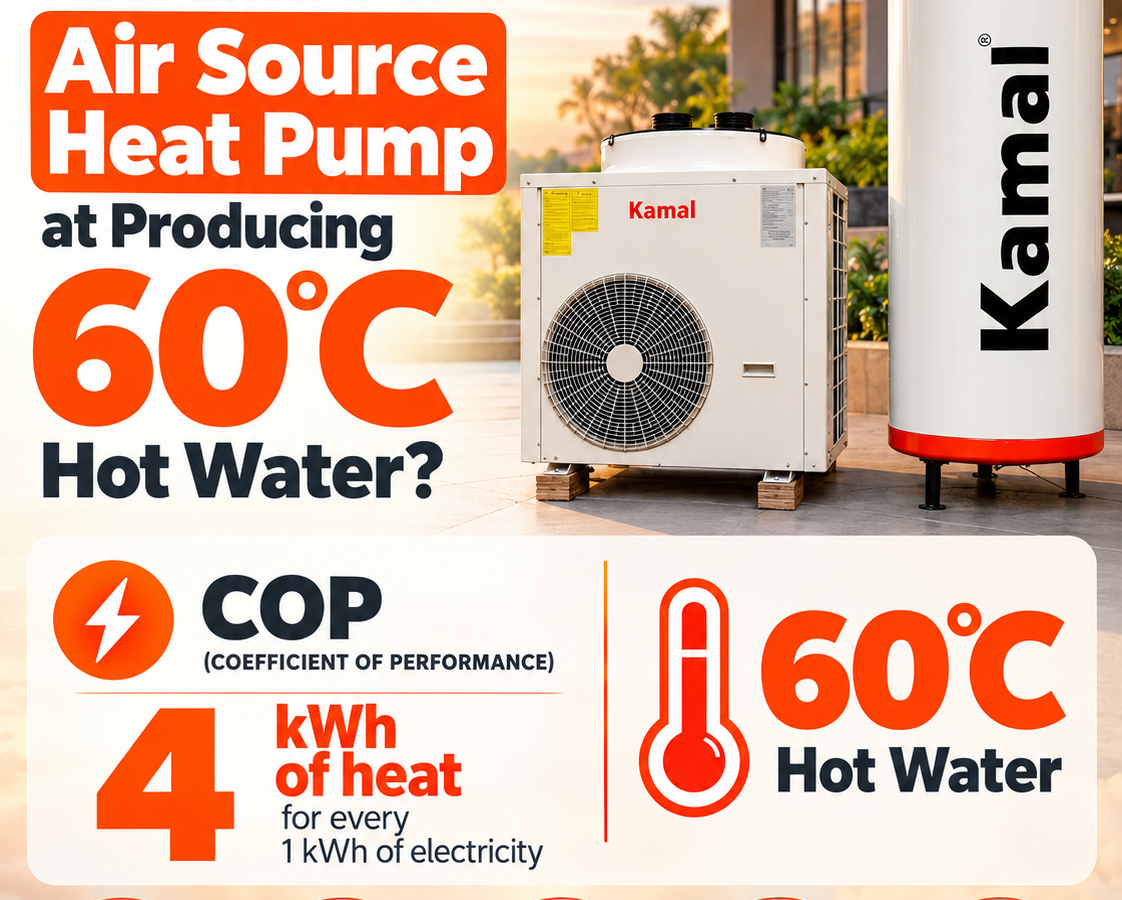
Air source heat pumps are becoming increasingly popular for heating water in homes, hotels, hospitals, hostels, apartments and commercial buildings. One of the most common questions is:
How efficient is a heat pump when producing hot water at 60°C?
The answer depends mainly on the ambient temperature and the required water temperature.
What is COP?
COP, or Coefficient of Performance, tells us how efficiently a heat pump converts electricity into useful heat.
For example, a heat pump with a COP of 4 produces approximately 4 kWh of heat for every 1 kWh of electricity consumed.
However, COP is not a fixed number. It changes with operating conditions.
How Does Ambient Temperature Affect COP?
An air source heat pump extracts heat from the surrounding air. When the ambient temperature is higher, there is more heat available and the compressor generally has less work to do.
Therefore, COP usually increases as ambient temperature increases.
For a heat pump producing 60°C water, a typical performance range could look approximately like this:
| Ambient Temperature | Water Temperature | Typical COP |
| 10°C | 60°C | 2.5–3.2 |
| 20°C | 60°C | 3.1–3.8 |
| 25°C | 60°C | 3.4–4.1 |
| 30°C | 60°C | 3.6–4.4 |
| 35°C | 60°C | 3.8–4.6 |
These figures are indicative. Actual performance varies depending on the compressor, refrigerant, heat exchangers, controls and overall heat-pump design.
Is COP Directly Proportional to Ambient Temperature?
No.
COP does increase with ambient temperature, but it is not directly proportional to it.
The more important factor is the temperature difference, or temperature lift, between the heat source and the required water temperature.
For example, producing 60°C water when the ambient temperature is 30°C is much easier than producing 60°C water when the ambient temperature is 10°C.
This is why a heat pump may deliver a much higher COP during warm Indian weather than during colder conditions.
What Is a Good COP for 60°C Water?
For Indian conditions, a COP of around 3.5–4.5 at 60°C water output can be considered a strong performance depending on the ambient temperature and equipment design.
However, when comparing different heat pumps, don’t look only at the advertised maximum COP.
Always ask for the COP and heating capacity at a specific operating condition, such as:
A30/W60 — 30°C ambient air and 60°C water outlet temperature.
This provides a much more meaningful comparison.
Conclusion
Air source heat pumps can efficiently produce 60°C hot water, particularly in India’s warmer climate. However, their efficiency depends on both ambient temperature and the required water temperature.
Higher ambient temperature + lower required water temperature = higher COP.
For commercial and domestic hot-water applications, evaluating the heat pump at the actual operating conditions is the best way to determine its true efficiency.
It is also possible to achieve higher COP values by using premium compressors, advanced refrigerants, larger and more efficient heat exchangers, variable-speed technology and better system controls. However, these improvements come with a significantly higher equipment cost. Therefore, the highest possible COP is not always the most economical solution. A well-designed heat pump should provide the right balance between COP, initial investment, reliability and long-term operating cost for the intended application.
Leave a Reply