
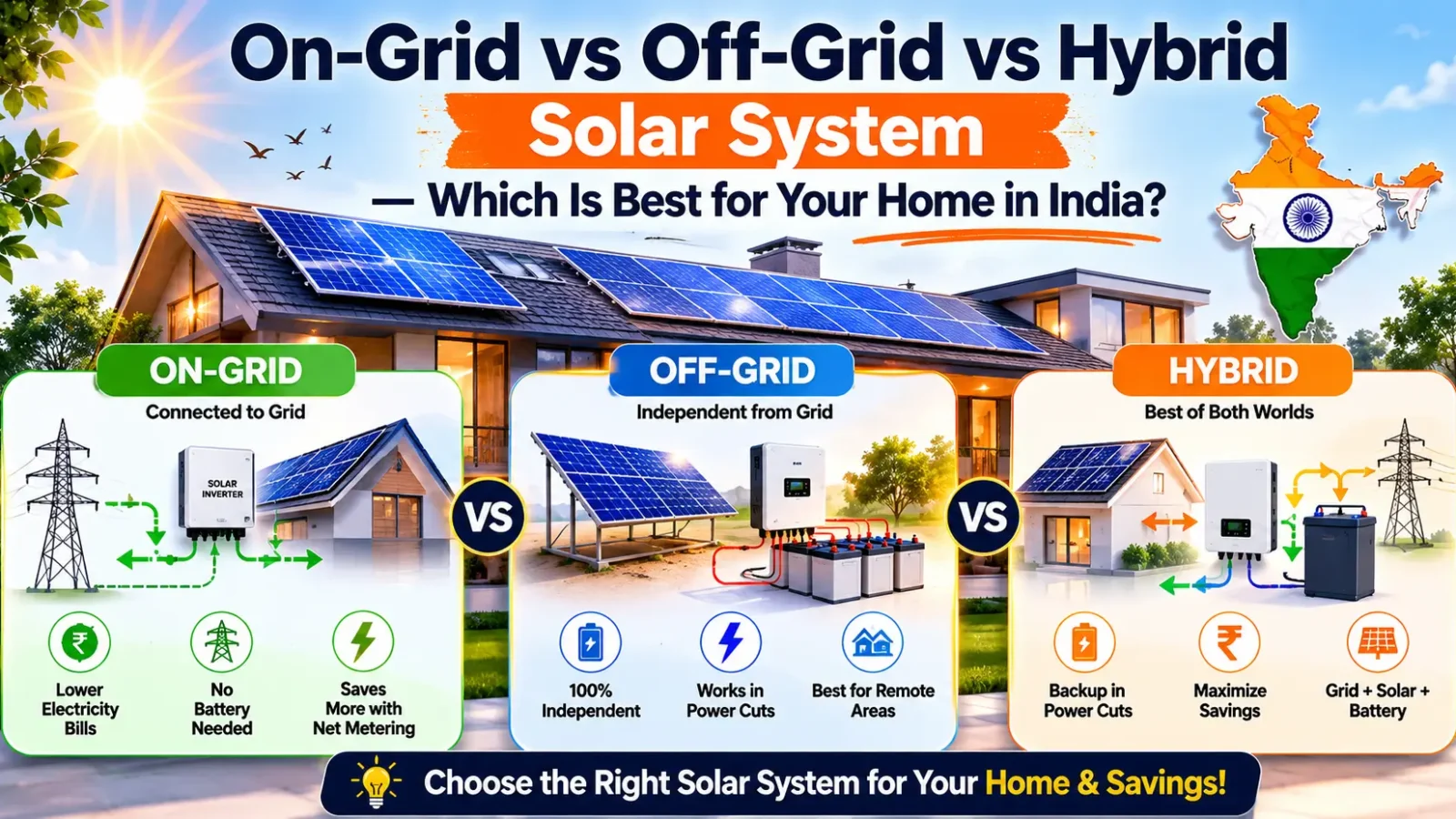
Thinking about switching to solar? You’ve probably already hit the first big question: on-grid, off-grid, or hybrid — what’s the difference and which one should you actually buy?
Most solar companies give you a confusing spec sheet and leave you to figure it out. We’re going to do the opposite.
This guide breaks down all three solar system types in plain language — what they cost, how they work, who they’re right for, and what makes sense for most Indian homes in 2025.
By the end, you’ll know exactly which system to choose.
WHAT IS AN ON-GRID SOLAR SYSTEM?
An on-grid solar system (also called a grid-tied system) connects your solar panels directly to the electricity grid. Your panels generate power during the day, your home uses what it needs, and any surplus power is exported back to the grid.
In exchange, your electricity provider credits you for the units you export — this is called net metering.
How On-Grid Works
- Solar panels generate DC electricity during daylight hours
- The inverter converts DC to AC for home use
- Your home appliances run on solar power
- Surplus electricity is sent to the grid (you earn credits)
- At night or on cloudy days, you draw power from the grid as usual
On-Grid System Cost in India (2025)
1 kW — Typical Cost: Rs. 60,000 to Rs. 75,000 | After PM Surya Ghar Subsidy: Rs. 30,000 to Rs. 45,000
3 kW — Typical Cost: Rs. 1,50,000 to Rs. 1,80,000 | After Subsidy: Rs. 90,000 to Rs. 1,20,000
5 kW — Typical Cost: Rs. 2,40,000 to Rs. 2,80,000 | After Subsidy: Rs. 1,60,000 to Rs. 2,00,000
10 kW — Typical Cost: Rs. 4,50,000 to Rs. 5,50,000 | After Subsidy: Rs. 3,50,000 to Rs. 4,50,000
Note: Costs vary by panel brand, inverter type, and installation complexity.
Pros of On-Grid Solar
- Lowest upfront cost — no batteries required
- Eligible for PM Surya Ghar subsidy (up to Rs. 78,000 for residential)
- Net metering credits reduce your electricity bills to near zero
- Low maintenance — fewer components, simpler system
- Faster ROI — typically 3 to 5 years
Cons of On-Grid Solar
- No power during grid outages — the system shuts down automatically for safety
- Dependent on grid availability — doesn’t work well in areas with frequent power cuts
Who Should Choose On-Grid?
On-grid is ideal if:
- You live in a city or urban area with reliable grid power (less than 2 hours of cuts per day)
- You want to maximise government subsidies
- Your primary goal is reducing monthly electricity bills
- You don’t want to deal with battery maintenance
Kamal Solar Recommendation: For most urban Indian homeowners in 2025, on-grid is the smartest financial decision. Maximum subsidy, fastest payback, zero battery headaches.
WHAT IS AN OFF-GRID SOLAR SYSTEM?
An off-grid solar system is completely independent from the electricity grid. It generates power, stores it in a battery bank, and runs your home entirely from that stored energy — with no grid connection at all.
How Off-Grid Works
- Solar panels generate DC electricity during the day
- A charge controller manages power flow to the battery bank
- Batteries store surplus energy
- The inverter converts battery DC power to AC for home use
- Your home runs 24/7 on stored solar energy
Off-Grid System Cost in India (2025)
1 kW (small home) — Rs. 1,20,000 to Rs. 1,60,000
3 kW (medium home) — Rs. 2,80,000 to Rs. 3,80,000
5 kW (larger home) — Rs. 4,50,000 to Rs. 6,00,000
Off-grid systems cost significantly more due to battery banks. Battery replacement is needed every 5 to 7 years (lithium) or 3 to 5 years (lead acid).
Pros of Off-Grid Solar
- Fully independent — works even in areas with no grid connection
- Power available 24/7 — no dependency on DISCOM availability
- Ideal for remote locations — farms, resorts, villages, construction sites
Cons of Off-Grid Solar
- Highest upfront cost — battery banks are expensive
- Not eligible for net metering or PM Surya Ghar subsidy in most states
- Battery maintenance and replacement costs add to long-term expense
- Slower ROI — typically 7 to 10 years
- Limited capacity — you must size your system carefully; overconsumption drains batteries
Who Should Choose Off-Grid?
Off-grid is the right choice if:
- You are in a rural area with no grid connection or extremely unreliable supply (8+ hours of outages daily)
- You are setting up a farm, resort, or remote facility
- Grid extension costs are prohibitive
- You genuinely want complete energy independence
WHAT IS A HYBRID SOLAR SYSTEM?
A hybrid solar system is the best-of-both-worlds solution. It connects to the grid like an on-grid system AND has a battery bank like an off-grid system.
During the day, your panels power your home. Surplus charges the batteries. When batteries are full, excess goes to the grid. At night, you draw from your batteries first — and from the grid only if batteries run out.
How Hybrid Works
- Solar panels generate power during the day
- Home appliances run on solar first
- Surplus energy charges the battery bank
- Once batteries are full, surplus exports to grid (if net metering is active)
- At night, batteries power the home
- Grid kicks in as backup only when needed
Hybrid Solar System Cost in India (2025)
3 kW — Rs. 2,50,000 to Rs. 3,20,000
5 kW — Rs. 3,80,000 to Rs. 4,80,000
10 kW — Rs. 6,50,000 to Rs. 8,50,000
Costs depend on battery capacity (kWh) and whether lithium-ion or lead-acid batteries are used.
Pros of Hybrid Solar
- Power backup during outages — batteries keep critical loads running
- Grid connection — net metering still applies in most states
- Best suited for Indian conditions — handles both grid outages and high daytime generation
- Smart energy management — modern hybrid inverters optimise usage automatically
- Future-proof — you can start without batteries and add them later
Cons of Hybrid Solar
- Higher cost than on-grid — battery addition increases investment
- Battery maintenance still required (though less than full off-grid)
- Subsidy eligibility may be reduced in some states (check local DISCOM rules)
Who Should Choose Hybrid?
Hybrid is ideal if:
- You face 4 to 6 hours of daily power cuts
- You want backup power for essentials (fans, lights, refrigerator) during outages
- You are in a semi-urban or Tier 2 city with inconsistent grid supply
- You want the flexibility of grid connection plus battery independence
ON-GRID VS OFF-GRID VS HYBRID: SIDE-BY-SIDE COMPARISON
Grid Connection:
On-Grid — Yes | Off-Grid — No | Hybrid — Yes
Battery Storage:
On-Grid — No | Off-Grid — Yes | Hybrid — Yes
Works During Outage:
On-Grid — No | Off-Grid — Yes | Hybrid — Yes
Net Metering:
On-Grid — Yes | Off-Grid — No | Hybrid — Usually
PM Surya Ghar Subsidy:
On-Grid — Full eligibility | Off-Grid — Not eligible | Hybrid — Partial
Upfront Cost:
On-Grid — Lowest | Off-Grid — Highest | Hybrid — Medium
ROI Period:
On-Grid — 3 to 5 years | Off-Grid — 7 to 10 years | Hybrid — 5 to 7 years
Best For:
On-Grid — Urban, reliable grid | Off-Grid — Remote, no grid | Hybrid — Semi-urban, frequent cuts
Maintenance:
On-Grid — Low | Off-Grid — High | Hybrid — Medium
WHICH SOLAR SYSTEM IS BEST FOR INDIAN HOMES IN 2025?
Here is the honest answer: it depends on your location and how often your power goes out.
Choose On-Grid if you are in Bangalore, Mumbai, Delhi, Hyderabad, Pune, or any major city with fewer than 2 hours of power cuts per day. Maximum subsidy, fastest payback, lowest hassle.
Choose Hybrid if you are in a Tier 2 city like Mysore, Nagpur, Coimbatore, or Lucknow with 3 to 6 hours of daily power cuts. You want backup power for essentials without completely going off-grid.
Choose Off-Grid if you are on a farm, in a village with no grid connection, or running a remote facility where grid connection is not feasible.
For 90% of Indian homeowners, the choice is between on-grid and hybrid. If your grid is reliable, go on-grid. If cuts are frequent, invest in hybrid.
HOW MUCH CAN YOU SAVE WITH SOLAR IN INDIA?
Monthly Bill Rs. 2,000 — Annual Savings: Rs. 20,000 to Rs. 22,000 — Payback Period: 4 to 5 years
Monthly Bill Rs. 5,000 — Annual Savings: Rs. 55,000 to Rs. 60,000 — Payback Period: 3 to 4 years
Monthly Bill Rs. 10,000 — Annual Savings: Rs. 1,10,000 to Rs. 1,20,000 — Payback Period: 3 years
After payback, solar generates free electricity for 20 to 25 years.
GOVERNMENT SUBSIDIES AVAILABLE IN 2025
PM Surya Ghar Muft Bijli Yojana
The central government’s flagship solar scheme offers:
Up to 2 kW — Rs. 30,000 per kW
2 kW to 3 kW — Rs. 18,000 per kW
Above 3 kW — Capped at Rs. 78,000
Eligibility: Residential properties, on-grid systems only. Apply through the PM Surya Ghar portal or your local DISCOM.
Contact Kamal Solar to check your subsidy eligibility.
FREQUENTLY ASKED QUESTIONS
Q: Can I add batteries to my on-grid system later?
A: Yes — a hybrid inverter allows you to add battery storage to an existing on-grid setup. This is a popular upgrade path. Just ensure your original inverter is hybrid-compatible before purchasing.
Q: Which solar system is best for a home with frequent power cuts?
A: A hybrid solar system is the best choice for homes experiencing 3 to 6 hours of daily power outages. It gives you battery backup during cuts while keeping you connected to the grid for net metering benefits.
Q: Is off-grid solar worth it in Indian cities?
A: Rarely. Off-grid systems cost significantly more, don’t qualify for government subsidies, and offer no net metering benefits. In cities with functional grids, on-grid or hybrid systems deliver far better returns.
Q: Does a hybrid solar system qualify for PM Surya Ghar subsidy?
A: It depends on your state’s DISCOM policy. In most states, grid-connected hybrid systems do qualify — but battery capacity may affect the eligible subsidy amount. Contact your installer or DISCOM for confirmation.
Q: How long do solar panels last in India?
A: Quality solar panels have a 25-year performance warranty. Most panels retain 80 to 85% efficiency after 25 years. Inverters typically last 10 to 15 years and may need one replacement over the system’s lifetime.
Q: What size solar system do I need for my home?
A: A simple formula: divide your monthly electricity consumption (units) by 30, then by 4 to 5 (average peak sun hours in India). For example, a home consuming 300 units per month needs approximately a 3 kW system.
Q: Can solar panels work on cloudy days?
A: Yes — solar panels generate electricity from daylight, not direct sunlight. Output is reduced by 20 to 50% on cloudy days, but generation continues. India’s average of 300+ sunny days per year makes solar highly effective.
WHY CHOOSE KAMAL SOLAR?
At Kamal Solar, we have helped hundreds of homeowners across India switch to solar with zero confusion. We don’t believe in one-size-fits-all — we assess your consumption pattern, grid reliability, budget, and subsidy eligibility before recommending a system.
- Free site survey and system recommendation
- End-to-end installation and commissioning
- Subsidy application assistance
- AMC (Annual Maintenance Contracts) available
- Transparent pricing — no hidden costs
Get a Free Solar Consultation Today. Call us or fill out the form below and our solar expert will contact you within 24 hours.
Leave a Reply