
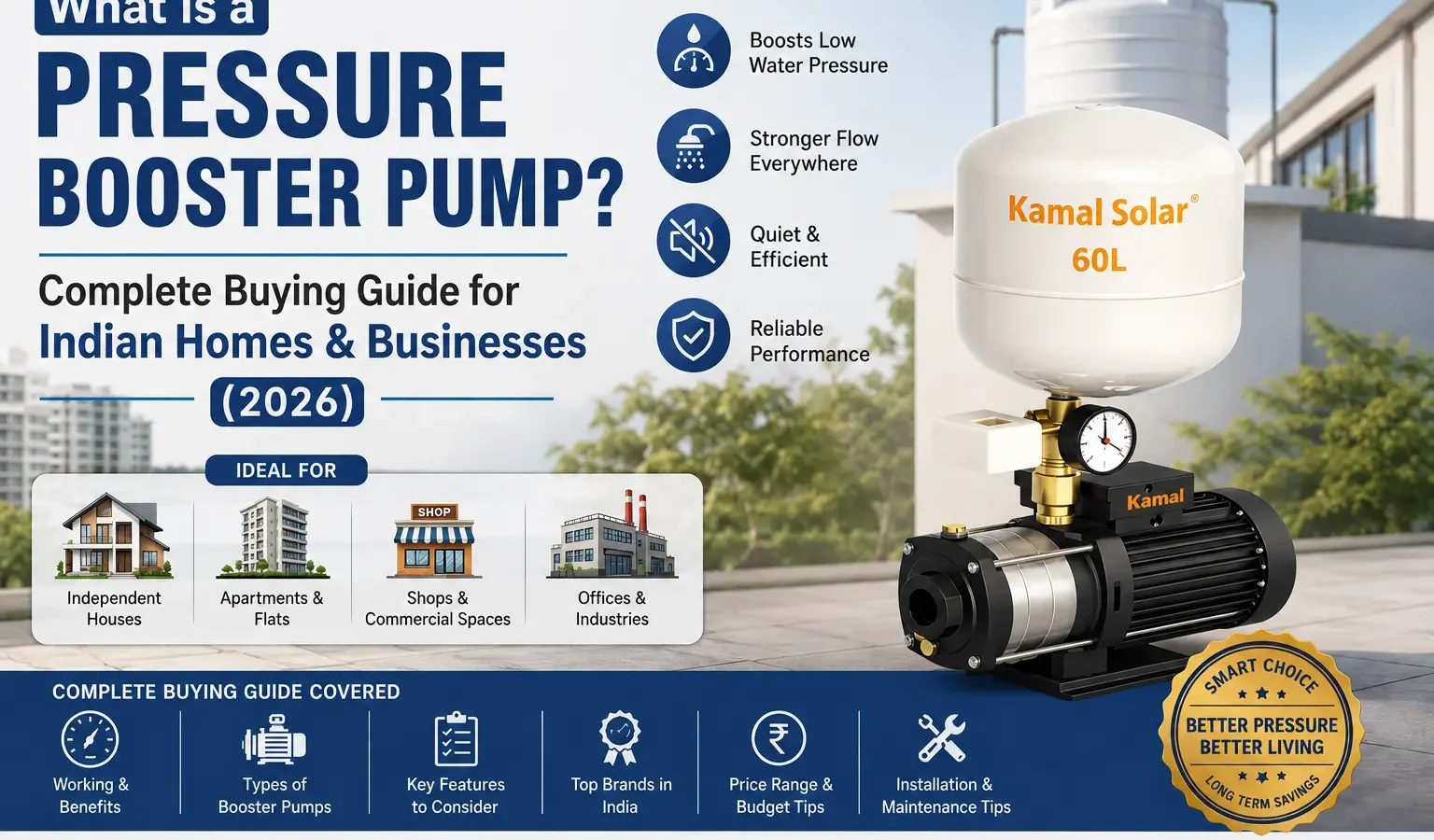
A pressure booster pump is a device that increases low water pressure in your home or building, ensuring consistent flow at every tap, shower, and appliance. If your morning shower feels like a drizzle, your solar water heater takes forever to fill, or water barely reaches the upper floors of your building — a pressure booster pump is the fix. In this guide, we cover how these pumps work, the types available in India, how to choose the right one, price ranges, and where they are most commonly used — from independent homes to large commercial buildings.
What Causes Low Water Pressure in Indian Homes and Buildings?
Low water pressure is one of the most common plumbing complaints in India, especially in urban areas. The problem is more widespread than most people realise and is rarely caused by a single factor.
The most common reasons include ageing municipal supply pipes that lose pressure over distance, multi-storey apartment buildings where gravity reduces pressure on upper floors, overhead tanks positioned too low relative to bathrooms and kitchen outlets, peak usage hours when municipal supply pressure drops, clogged or corroded pipes in older buildings, and solar water heater installations that require a minimum inlet pressure to function correctly.
In cities like Bangalore, Mumbai, and Hyderabad, apartments above the 3rd or 4th floor frequently experience water pressure that drops below the 10 PSI minimum needed for a satisfying shower. Most modern bathroom fittings, water purifiers, and solar water heaters require between 20 and 40 PSI to work efficiently.
A pressure booster pump solves all of these issues by drawing water from your storage tank or municipal line and delivering it at consistent, usable pressure throughout your property.
How Does a Pressure Booster Pump Work?
A pressure booster pump works by using an electric motor to drive an impeller — a rotating component that accelerates water and forces it through the outlet at higher pressure. Most modern booster pumps used in homes and apartments are automatic: they sense when a tap or shower is opened via a pressure or flow sensor, switch on instantly, and shut off automatically when water stops flowing.
The key components are the pump body and impeller, an electric motor (typically 0.5 HP to 2 HP for residential use), a pressure switch or flow sensor for automatic operation, and a pressure tank in some systems that stores pressurised water to reduce how often the motor needs to start.
Because they are self-priming and compact, modern booster pumps can be installed inline on an existing pipe — no major plumbing overhaul required.
Types of Pressure Booster Pumps Available in India
Understanding the different types helps you choose the right system for your specific requirement.
Single-Stage Booster Pumps are the most common for residential use. They use one impeller stage and are well-suited for homes with 1 to 3 bathrooms where modest pressure increases are needed. They are compact, affordable, and easy to install.
Multistage Booster Pumps use two or more impeller stages in series to build significantly higher pressure. These are used in high-rise buildings, hospitals, hotels, and any application requiring consistent high-pressure water delivery across multiple floors or multiple simultaneous outlets.
Inline Booster Pumps are installed directly in the water supply pipe with no separate tank. They are the simplest type to retrofit into an existing plumbing system and are ideal for homes, individual flats, and small offices.
Hydropneumatic (Pressure Tank) Systems combine a booster pump with a pressurised tank. The tank stores a volume of water at target pressure so the pump does not need to cycle on and off every time a tap is opened. These are preferred for large apartment complexes, housing societies, hotels, and hospitals where demand is continuous and pump longevity is critical.
Solar Water Heater-Compatible Pressure Pumps are designed specifically for pressurised solar water heater installations. These are low-noise, corrosion-resistant models that handle hot water and maintain the inlet pressure required for FPC pressurised systems to deliver hot water consistently on upper floors.
Who Needs a Pressure Booster Pump? Key Applications
Pressure booster pumps are not just for homes with low municipal supply. They are used across a wide range of residential and commercial applications.
Independent homes and villas commonly use booster pumps when the overhead tank is not elevated high enough, or when the distance from the tank to bathrooms results in pressure loss.
Apartments and high-rise residential buildings are among the biggest users. Buildings above 3 to 4 floors almost always need a pressure boosting system on the main supply line or at individual flat level to compensate for the pressure loss caused by elevation.
Housing societies and gated communities require centralised pressure boosting systems — typically hydropneumatic — that can handle simultaneous demand from hundreds of flats without motor fatigue.
Hotels, resorts, and guest houses need consistent, strong water pressure in every room at every time of day. A single-point pressure failure in a hotel means complaints and lost bookings. Multistage or hydropneumatic systems are the standard solution here.
Hospitals and healthcare facilities operate under strict standards where water pressure must be reliably maintained for patient wards, OT preparation areas, laundry, and kitchen operations.
Solar water heater installations frequently require a booster pump, especially in FPC pressurised systems. These systems need a minimum inlet pressure to push water through the collector and deliver hot water at adequate flow rates. In areas with low municipal pressure or upper-floor installations, a booster pump is not optional — it is essential.
How to Choose the Right Pressure Booster Pump
Choosing the wrong pump is the most common and costly mistake. The right pump depends on your specific usage pattern, not just the cheapest option available.
The number of bathrooms and outlets is the primary sizing factor. For 1 to 2 bathrooms, a 0.5 HP single-stage pump is sufficient. For 3 to 5 bathrooms or multi-floor homes, a 1 HP pump is recommended. For apartment complexes, hotels, or hospitals, multistage or hydropneumatic systems starting from 2 HP are appropriate.
Flow rate in litres per minute matters as much as pressure. A single shower requires approximately 8 to 12 LPM. A family of four typically needs 30 to 50 LPM during peak morning use. Always check the pump’s flow rate specification, not just its horsepower.
Automatic operation via pressure or flow switch is essential for residential use. Manual start pumps are impractical for daily household use and risk dry-run motor damage.
Noise level is a concern in apartments and hotels. Look for pumps specifically rated for low-noise or silent operation — particularly important when the pump is installed near bedrooms or common areas.
Hot water compatibility must be confirmed if the pump will work with a solar water heater or heat pump. Standard pumps are cold-water rated only. Pumps paired with solar heater systems must be rated for hot water service, typically up to 90°C, and made from corrosion-resistant materials.
Pressure Booster Pump Price in India (2026)
Prices vary based on HP rating, brand, type, and whether installation is included.
Residential single-stage pumps (0.5 HP to 1 HP) range from approximately ₹4,000 to ₹12,000 for the unit alone. Brands like Crompton, Kirloskar, V-Guard, and Havells are widely available in this range.
Multistage pumps for apartments and small commercial buildings (1 HP to 2 HP) typically cost ₹12,000 to ₹30,000 depending on the number of stages and build quality.
Hydropneumatic systems for housing societies, hotels, and hospitals — including pump, tank, control panel, and installation — range from ₹40,000 to ₹2,00,000 or more depending on the required capacity.
Premium brands such as Grundfos and Wilo command a 30 to 50 percent price premium over comparable Indian brands but offer variable-speed drives, energy efficiency, and built-in fault diagnostics.
Installation in Bangalore typically adds ₹2,000 to ₹8,000 for a residential system. Always request a site inspection before purchase — the right system for your property cannot be determined from a product listing alone.
Pressure Booster Pump for Solar Water Heaters — A Critical Pairing
One application that is frequently overlooked is pairing a pressure booster pump with a solar water heater system. This is particularly important for FPC (Flat Plate Collector) pressurised solar water heaters, which are common in apartments, villas, and commercial buildings.
FPC pressurised systems rely on incoming supply pressure to push heated water from the collector to outlet points. When municipal pressure is low — which is common during early morning and late evening peak hours in Indian cities — hot water delivery becomes weak or stops entirely. Many homeowners assume the solar heater is faulty when the real cause is simply insufficient inlet pressure.
A correctly sized booster pump installed on the cold water inlet to the solar heater solves this completely. It ensures the collector is always fed at adequate pressure, the tank fills correctly, and hot water reaches upper-floor bathrooms at a consistent flow rate regardless of municipal supply conditions.
At Kamal Solar, inlet pressure assessment is part of every solar water heater site visit. When required, we supply and install the appropriate booster pump as part of the overall system so your solar heater performs as designed from day one.
Why Choose Kamal Solar for Pressure Booster Pumps in Bangalore and Karnataka?
Kamal Solar (Velnet Non-Conventional Energy Systems Pvt. Ltd.) has been supplying, installing, and servicing pressure booster pump systems across Bangalore and Karnataka since 1998. With over 400,000 system installations, we have deep practical knowledge of the water pressure challenges specific to different areas, building types, and usage patterns across the region.
We supply and install residential and commercial pressure boosting systems — from a simple single-pump installation for an independent home to full hydropneumatic systems for housing societies, hotels, and hospitals. Our technical team conducts a thorough site assessment before recommending any system.
Because we also manufacture and install solar water heaters and heat pumps, we are uniquely placed to advise on integrated hot water systems where pressure boosting is part of a larger solar installation.
Our Bangalore-based service team handles maintenance, repairs, and AMC support across the city and surrounding districts.
Frequently Asked Questions — Pressure Booster Pumps
What is the best pressure booster pump for a home in India? For a typical Indian home with 2 to 3 bathrooms, a 0.5 HP to 1 HP automatic single-stage booster pump from brands like Crompton, Kirloskar, or Havells is sufficient. For larger homes or multi-floor buildings, a 1 HP to 1.5 HP multistage pump is recommended. The right choice depends on your floor height, number of outlets, and simultaneous usage — a site assessment gives you a definitive answer.
How much does a pressure booster pump cost in India? Residential pressure booster pumps range from ₹4,000 to ₹15,000 for single-stage units. Multistage pumps for apartments range from ₹12,000 to ₹30,000. Hydropneumatic systems for housing societies or hotels start from ₹40,000. Installation charges are additional and vary by complexity.
Can a pressure booster pump be used with a solar water heater? Yes — and for pressurised FPC solar water heater systems, it is often essential. A booster pump ensures adequate inlet pressure to the solar collector so hot water is delivered at consistent flow rates to all outlets, even during low municipal pressure periods.
How long does a pressure booster pump last? A well-maintained pressure booster pump typically lasts 8 to 12 years. In areas with hard water, an annual service checking seals, bearings, and impeller wear is recommended.
Does a pressure booster pump significantly increase electricity bills? No. A 0.5 HP residential pump running 2 to 3 hours per day consumes roughly 1 to 1.5 units of electricity daily — approximately ₹30 to ₹50 per month added to your bill. Variable-speed models consume even less by adjusting motor speed to actual demand.
What is a hydropneumatic pressure system? A hydropneumatic system combines one or more booster pumps with a pressurised tank. The tank stores water at target pressure so the pump does not need to start every time a tap is opened. These systems are used for housing societies, hotels, hospitals, and commercial buildings where water demand is continuous.
Ready to solve low water pressure in your home or business?
Call Kamal Solar at +91 88844 79199 or WhatsApp us for a free consultation. Our team covers all areas of Bangalore and Karnataka — we assess your site, recommend the right system, and handle complete installation.
Leave a Reply