
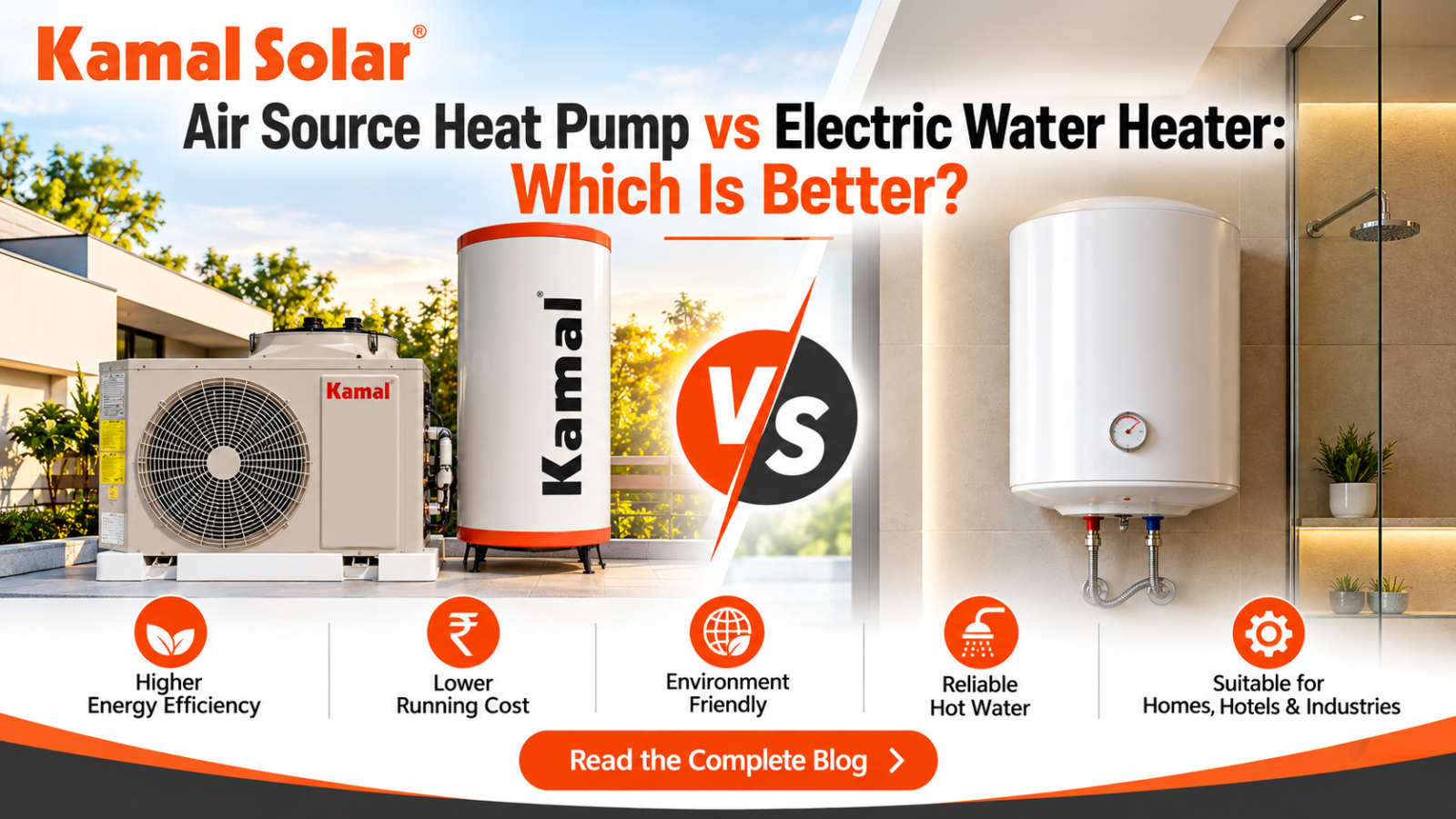
Choosing the right water heating system can make a significant difference to your electricity bills. Homes, hotels, hospitals, hostels, apartments, and commercial buildings need reliable hot water, but the cost of heating water can vary considerably depending on the technology used.
Two common options are the air source heat pump water heater and the conventional electric water heater, commonly known as a geyser.
But which is better? Is a heat pump more energy-efficient than an electric geyser, and how much electricity can you save by switching?
In this guide, we compare heat pump vs electric heater systems based on electricity consumption, efficiency, running costs, installation, and long-term value.
1. What Is an Air Source Heat Pump Water Heater?
An air source heat pump water heater extracts thermal energy from the surrounding air and transfers it to water using a refrigeration cycle.
Electricity powers the compressor, fans, and controls, while the surrounding air provides additional thermal energy.
Because a heat pump transfers heat rather than generating all the heat directly from electricity, it can deliver several units of useful heat for every unit of electricity consumed under suitable operating conditions.
Heat pump water heaters are commonly considered for residential properties, hotels, hospitals, hostels, apartments, and commercial facilities with substantial hot water demand.
2. What Is an Electric Water Heater or Geyser?
A conventional electric water heater uses an electrical resistance heating element to heat water directly.
When electricity passes through the heating element, it generates heat, which is transferred to the water stored in the tank or flowing through the unit.
Electric geysers are widely used in homes and apartments because they are familiar, compact, and generally straightforward to install.
However, resistance heating typically requires approximately one unit of electricity for every unit of useful heat delivered at the point of heating, excluding standby and distribution losses.
3. Heat Pump vs Electric Heater: Key Differences
The main difference is how each system produces hot water.
| Feature | Air source heat pump | Electric water heater |
| Heating method | Transfers heat from air | Generates heat using electrical resistance |
| Typical heating COP | Often around 2–4 or more, depending on conditions | Approximately 1 at the heating element |
| Electricity consumption | Generally lower for the same heating demand | Generally higher for the same heating demand |
| Initial investment | Usually higher | Usually lower |
| Installation | Requires suitable space and airflow | Usually simpler |
| Operating cost | Often lower | Often higher |
| Best suited for | Larger or regular hot water demand | Smaller or intermittent hot water demand |
The heat pump COP range is illustrative, not a guarantee for every model. Actual performance depends on ambient temperature, required water temperature, equipment design, and operating conditions.
4. Heat Pump Water Heater vs Geyser: Electricity Consumption
Electricity consumption is one of the most important factors when comparing these systems.
A conventional electric geyser converts electrical energy into heat through a resistance element. An air source heat pump transfers heat from the surrounding air and uses electricity to operate its components.
Consider an example in which a building requires 20 kWh of useful heat per day.
Example electricity consumption
| System | Assumed performance | Daily electricity use |
| Electric water heater | COP 1 | 20 units |
| Heat pump water heater | COP 2 | 10 units |
| Heat pump water heater | COP 3 | 6.67 units |
| Heat pump water heater | COP 4 | 5 units |
These calculations assume the same useful heating requirement and exclude differences in storage, distribution, and standby losses.
In this example, a heat pump operating at COP 3 uses approximately 66.7% less electricity than a resistance heater for the same useful heat output.
Actual savings depend on the heat pump’s real-world COP and the complete hot water system.
5. How Much Money Can You Save With a Heat Pump?
Your savings depend on the amount of hot water you use, the heat pump’s COP, and your electricity tariff.
For example, assume the following:
- Daily useful heat requirement: 20 kWh
- Electric geyser heating COP: 1
- Heat pump heating COP: 3
- Electricity tariff: ₹8 per unit
- Usage: 30 days per month
Monthly running cost comparison
| Calculation | Electric geyser | Heat pump |
| Daily electricity consumption | 20 units | 6.67 units |
| Daily electricity cost | ₹160 | ₹53.36 |
| Monthly electricity cost | ₹4,800 | Approximately ₹1,600 |
| Estimated monthly savings | — | Approximately ₹3,200 |
In this illustrative scenario, the heat pump reduces electricity consumption for water heating by approximately 66.7%.
These figures are examples rather than product guarantees. Your actual savings will depend on the required water temperature, ambient conditions, hot water demand, standby losses, and electricity tariff.
6. Which Is Better for Homes and Apartments?
For homes and apartments, the best choice depends on hot water usage and installation requirements.
An electric geyser may be suitable when:
- Hot water demand is relatively low.
- The initial purchase budget is limited.
- Hot water is required only occasionally.
- Installation space is restricted.
- A simple, familiar heating system is preferred.
A heat pump may be suitable when:
- Hot water is used regularly throughout the day.
- Several bathrooms or users need hot water.
- Reducing recurring electricity bills is a priority.
- Suitable outdoor space and airflow are available.
- The household expects to use the system for several years.
For smaller households, the higher initial cost of a heat pump may take longer to recover. A cost comparison should include installation, maintenance, energy use, and expected service life.
7. Heat Pump vs Electric Water Heater for Hotels and Commercial Buildings
Hotels, hospitals, hostels, resorts, and other commercial facilities often have higher and more consistent hot water requirements.
In these applications, electricity savings can become more significant because water heating operates for longer periods and serves more users.
Heat pump systems can be designed with storage tanks to meet peak demand and provide hot water throughout the day.
When planning a commercial installation, consider:
- Daily hot water consumption
- Peak-hour demand
- Required outlet water temperature
- Heat pump heating capacity
- Storage tank volume
- Recovery time
- Available electrical supply
- Installation space and airflow
- Maintenance and operating costs
A properly sized system is essential. An undersized heat pump may struggle to recover hot water during peak demand, while an incorrectly designed system may not achieve the expected efficiency.
8. Does a Heat Pump Work in Cold Weather?
Yes. Air source heat pumps can operate in cold weather, but their performance depends on the model and outdoor conditions.
As ambient air temperature decreases, the heat pump generally has to work harder to extract heat from the air. This can reduce COP and increase electricity consumption.
For locations with cooler winters, compare manufacturer performance data at the expected outdoor temperature and required hot water temperature.
For a fair comparison, evaluate both systems under the conditions in which they will actually be used.
9. How Long Does It Take to Recover the Initial Investment?
A heat pump usually has a higher initial purchase and installation cost than a conventional electric geyser. However, its lower running costs may offset the price difference over time.
A simple payback calculation is:
Payback Period = Additional Initial Cost ÷ Annual Electricity Cost Savings
For example, if a heat pump costs ₹60,000 more to purchase and install than a comparable electric heating system, and it saves ₹24,000 per year in electricity costs:
₹60,000 ÷ ₹24,000 = 2.5 years
This is an illustrative example, not a quotation or a guaranteed payback period.
A complete financial comparison should also account for maintenance, equipment lifespan, replacement costs, and changes in electricity tariffs.
10. How to Choose the Right Water Heating System
Before deciding between a heat pump and an electric water heater, evaluate your actual hot water requirements.
For a small household with limited hot water usage, an electric geyser may be a practical choice because of its lower initial cost.
For a hotel, hostel, apartment complex, hospital, or commercial building with substantial hot water demand, an air source heat pump may provide better long-term operating economics.
Compare the manufacturer’s heating capacity, COP at your required water temperature, storage capacity, and performance under local ambient conditions.
The best solution is the one that meets your hot water needs reliably while providing an appropriate balance between initial investment and ongoing electricity costs.
Frequently Asked Questions
Is a heat pump more efficient than an electric geyser?
Generally, yes. A heat pump transfers heat from the surrounding air and can deliver multiple units of useful heat per unit of electricity. An electric resistance heater typically delivers approximately one unit of heat per unit of electricity at the heating element.
How much electricity can a heat pump save?
Savings depend on the heat pump’s actual COP and the required heating demand. For example, at COP 3, a heat pump uses approximately 66.7% less electricity than a resistance heater for the same useful heat output under the assumed conditions.
Is a heat pump water heater worth the investment?
It can be worthwhile when hot water demand is substantial and regular. Lower running costs may offset the higher initial investment, but the payback period depends on equipment costs, electricity tariffs, and actual usage.
Which is better for a hotel: a heat pump or an electric heater?
A properly sized heat pump can be attractive for hotels because of their regular hot water demand and potential electricity savings. The final choice depends on required capacity, operating conditions, installation costs, and recovery time.
Can a heat pump replace an electric geyser?
Yes, a suitably designed heat pump system can replace an electric water heater. Check the required water temperature, hot water demand, installation space, and compatibility with existing plumbing before making the change.
Conclusion: Heat Pump vs Electric Water Heater
Both heat pumps and electric geysers can provide hot water, but they work differently and have different operating costs.
An electric geyser may be appropriate for smaller or occasional hot water requirements. An air source heat pump can be a more energy-efficient choice for households and commercial facilities that use substantial amounts of hot water.
By comparing electricity consumption, running costs, installation expenses, and expected usage, you can choose the right solution for your needs.
Kamal Solar provides heat pump solutions for residential and commercial hot water applications. Evaluate your hot water demand and compare model-specific performance data to identify a suitable system for your property or business.
Leave a Reply